


.jpg)
As retailers, fashion brands and marketplaces move toward more transparent supply chains, one of the most common questions leaders ask is: “What is the best carbon accounting tool for my business?”
There is no single tool that fits every company, but the strongest solutions share a few characteristics: reliable data, automation, sector-specific modeling and the ability to support emerging frameworks and regulation changes such as stricter Scope 3 reporting, Digital Product Passports and France’s Environmental Cost labels (“Eco-Scores”).
It’s also increasingly important to note that companies are no longer focused on carbon in isolation. Evolving regulations, reporting frameworks and consumer expectations mean many brands now need visibility across multiple environmental impact categories, including waste, water use, fossil fuel dependency, toxicity and more.
As a result, choosing the right tool may need to factor in going beyond basic carbon accounting and be capable of calculating, comparing and communicating a broader set of environmental metrics at the product and supply chain level.
This guide breaks down the key categories of carbon accounting tools available today and highlights the most important factors when choosing one for retail and fashion.
What counts as a carbon and/or impact accounting tool?
“Carbon accounting tools” generally fall into three groups.
- Corporate carbon accounting software (most popular for large corporations)
- Tools designed to calculate a company’s overall footprint (Scopes 1, 2 and 3) using a combination of a combination of data, including activity data, spend data, and emission factors.
- Best for: annual reporting, high-level dashboards, corporate sustainability teams.
- Product-level LCA & footprinting tools (saturated market)
- Platforms that measure the impact of individual products or materials using life cycle assessment (LCA) methods.
- Best for: brands with complex product ranges, design teams, sustainability analysts.
- Retail- and circularity-focused carbon/impact management platforms (rare)
- Tools built specifically for retailers, brands, marketplaces and circular business models such as resale, rental or refill.
- These tools combine product-level modeling with real operational data to show the impact of manufacturing, logistics, returns, end-of-life and circular activity.
While there are fewer options available in the third category, retail companies typically benefit most from the latter, because these tools directly reflect how the sector operates. The most purpose-built tools should also offer a combination of capabilities across all three categories above, since each business differs from the next, and many forward-thinking companies are doing everything they can to control and reduce their impact, regardless of size or sector.
Key features to look for

When evaluating carbon accounting software for retail, fashion or marketplace businesses, these capabilities have become essential:
Product-level accuracy
Retail footprints are highly product-driven. Tools that can calculate impact at SKU level usually provide the most actionable insights.
Scope 3 automation
For most brands, Scope 3 impact and emissions represent 85-95% of total impact. Automated modeling, data ingestion and supply chain mapping make Scope 3 manageable at scale.
Real-time or high-frequency updates
Instead of waiting for annual reports, modern tools use dedicated technology to sync with data systems (ERP, PLM, PIM, POS, and marketplace backends) and can reflect changes even as they happen.
Retail-sector modeling
Fashion, footwear, homeware and marketplace operations have unique supply chains: returns, assortment changes, multi-warehouse routing and circular flows all matter. Not all tools model these well, so a specifically-designed supply chain solution will work best.
Support for existing and emerging regulations, requirements and frameworks
DPPs, “Eco-Scores”, CSRD, packaging laws and textile-specific rules require more granular, verifiable data. Companies with a legislative focus and in-house legislative support will be able to offer more granular, attuned tooling.
Ability to actually measure circular impact
Many retailers now operate resale, rental, repair or recycling programs, but this data is not easy to crunch or forecast. Tools that accurately quantify avoided emissions or circular benefits, with a focus on circular innovation, provide a more complete picture.
Examples of carbon and impact accounting solutions used in retail
To understand “What is the best carbon accounting tool for retail?“, it’s helpful to look at how different types of solutions are used in the real world — and what they do well or poorly for brands, retailers and marketplaces.
1. Corporate carbon accounting (organization-level reporting)
This functionality helps companies calculate their total Scope 1, 2 and 3 emissions for annual reporting. They are often spend-based, which is useful for high-level disclosures but less precise than activity-based methodologies for SKU-level retail decisions.
Used by retail typically for:
- Annual carbon reporting
- Board-level dashboards
- Meeting investor or CSRD expectations
Where they can fall short:
- Lack of product-level detail (primary data, spend-based vs activity-based)
- Limited visibility into manufacturing routes, logistics or returns
- Cannot model circularity or dynamic assortments
Large multi-brand groups often start here because it satisfies baseline compliance, but move on to more granular solutions as they mature.
2. LCA and product footprinting (with deep material and manufacturing modeling)
Traditional LCA software or consultants are strong at materials analysis, process modeling and factory-level assessments. They’re widely used in footwear, apparel and accessories where design teams need to understand the impact of material choices.
Used for:
- One-off LCAs during design and development
- Understanding the impact of specific materials or manufacturing changes
- Validating new technologies (e.g., On’s LightSpray™ manufacturing innovation)
These tools alone are usually not built to ingest large assortments, dynamic inventory, multi-warehouse routing or circular flows like resale and repair, all of which define modern retail operations, and therefore provide limitations for retail.
3. Retail-specific carbon & impact management (real-time, SKU-level, operational)
This emerging category is built specifically for retail with brands, marketplaces and circular businesses at the heart of what they do. Operators in this intersection combine LCA-quality modeling (explored above) with operational, supply chain and sales data to produce accurate, up-to-date environmental insights at scale.
Used for:
- SKU-level LCA for full assortments
- Supply chain impact modeling (materials → manufacturing → logistics → end-of-life)
- Real-time capabilities
- Scope 3 automation
- Circular impact + avoided emissions (resale, rental, repair)
- Digital Product Passports (DPPs)
- Eco-Score automation and environmental labelling
- Customer-facing impact transparency
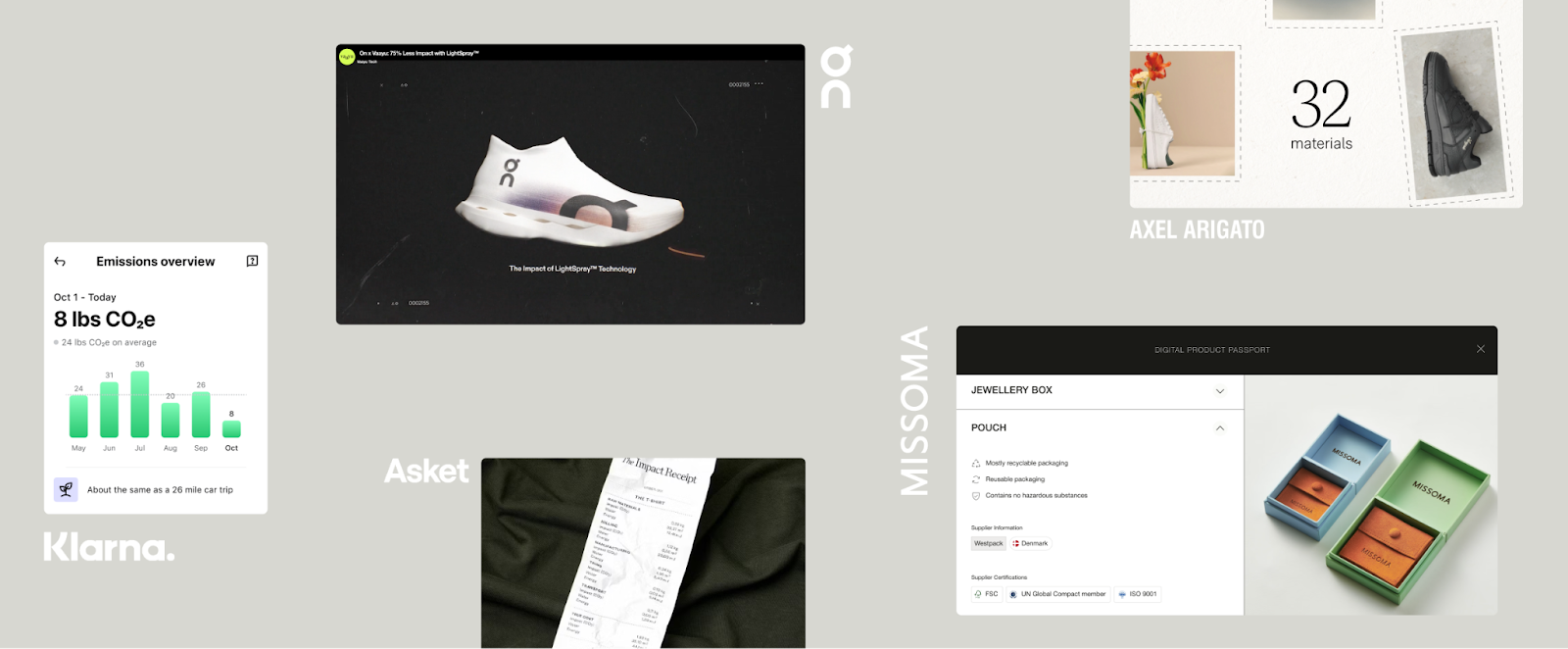
Real-world examples with Vaayu:
- Klarna: 225M product footprints calculated in real time and displayed to 150M+ shoppers across 45 markets.
- Missoma: Launched Digital Product Passports powered by Vaayu, improving traceability and transparency.
- On: Used prospective LCA to quantify the impact reduction of its LightSpray™ technology (~75% less CO₂e for the shoe upper).
- Axel Arigato: 270+ detailed product LCAs and full corporate footprint to identify Scope 3 hotspots and reduction opportunities.
- Asket: Product LCAs that power its Impact Receipt, giving customers product-level footprints rooted in real operational data.
This category is the best match for companies seeking accurate, scalable and retail-specific insights across multiple outcomes, especially where product complexity, supply chain variability and circular business models are core to the brand.
Vaayu sits in this category, designed specifically around the needs of modern retailers and fashion brands.
Where Vaayu fits
Vaayu is an AI-powered carbon and impact management platform designed for all retail brands, marketplaces and companies, including across fashion, apparel, footwear, eyewear, electronics, consumer goods and CPG, recommerce, beauty and fintech.
Vaayu calculates product-level and Scope 3 emissions, using a scientific modeling engine that ingests operational, supply chain and product data.
Retail brands and circular companies use Vaayu for:
- Product-level LCAs at scale
- Supply chain impact modeling
- Real-time carbon accounting
- Digital Product Passports
- “Eco-Score” automation and other legislative support
- Circular impact and avoided emissions
- Sustainability reporting
Since Vaayu is built around retail logic (complex assortments, returns, warehouses, last-mile, circular flows), grounded in deep in-house team expertise across the fashion sector and related retail verticals, its technology addresses impact insights and questions that general-purpose carbon tools often cannot.
Which carbon and impact accounting tool is “the best”?

There isn’t one universal answer because retailers, fashion brands and marketplaces have very different sustainability needs depending on their product mix, supply chain maturity and regulatory pressures.
Some companies need high-level organisational reporting, others need deep material-level analysis, and many now require real-time, SKU-level visibility to run credible climate programs and meet fast-evolving requirements.
The “best” tool is therefore the one that aligns with the specific decisions your teams need to make; from sourcing and design to operations, marketplace logistics and consumer transparency.
Choose a more corporate carbon accounting tool if…
- You want high-level Scope 1-3 reporting with minimal complexity.
Choose simpler LCA/product footprinting tools if…
- You need deep material and manufacturing analysis for specific SKUs or design-stage decisions.
Choose a retail-specific carbon management platform like Vaayu if…
- You operate in retail (e.g., marketplaces, fashion, footwear, beauty, homeware, fintech, consumer goods etc.) and need:
- Product-level data (e.g., modeling at the SKU level and/or category level)
- Automated Scope 3 calculations and management
- Circular impact measurement (e.g., avoided emissions, circular initiative impact)
- Digital supply chain traceability (e.g., mapping, DPPs, “Eco-Scores”)
- Some real-time functionality
- Integrated impact across all areas of the business in one central platform
For most marketplaces and brands operating in retail and fashion, this third category provides not only the clearest and most actionable results, as it’s the only approach that can keep pace with the complexity, speed and regulatory demands of modern retail. This provides teams with the insight they truly need to make meaningful, measurable progress.
Choosing the right carbon and impact management tool for your business
The “best carbon accounting tool” is the one that fits the realities of retail: fast-moving assortments, global supply chains, returns, circular activity and regulatory complexity.
Modern retail brands and companies increasingly choose platforms that:
- Automate Scope 3
- Calculate product-level impact
- Integrate with real data systems
- Model circular flows
- Support DPPs and Eco-Score
Tools like Vaayu are emerging as strong fits because they combine scientific accuracy with real-time data and a retail-first approach; something traditional carbon accounting or standalone LCA tools were never designed to do.
As the industry moves toward deeper regulatory scrutiny, multi-impact reporting and greater consumer transparency, retail brands need technology that can explain not just what their impact is, but why it’s happening and how to reduce it. Choosing a platform built for the realities of retail is both a smarter operational decision and a strategic advantage in a market where environmental performance is rapidly becoming a core part of brand value.
If your brand is ready to move beyond high-level calculations and start using real, product-level environmental insights to drive decisions across design, sourcing, supply chain, consumer transparency and more, Vaayu can help. Get in touch to see how Vaayu can support your sustainability goals and help you stay ahead of evolving regulations while delivering measurable impact across your entire business.


.png)
.png)

.png)